
Two-Phase Decanter
- Basket Diameter (mm) 250 - 720
- Feed Rate (m³/h) 1-50
- Main/Secondary Motor Power (kW) 11/4-110/22
- Machine Weight (kg) 1,200-12,000
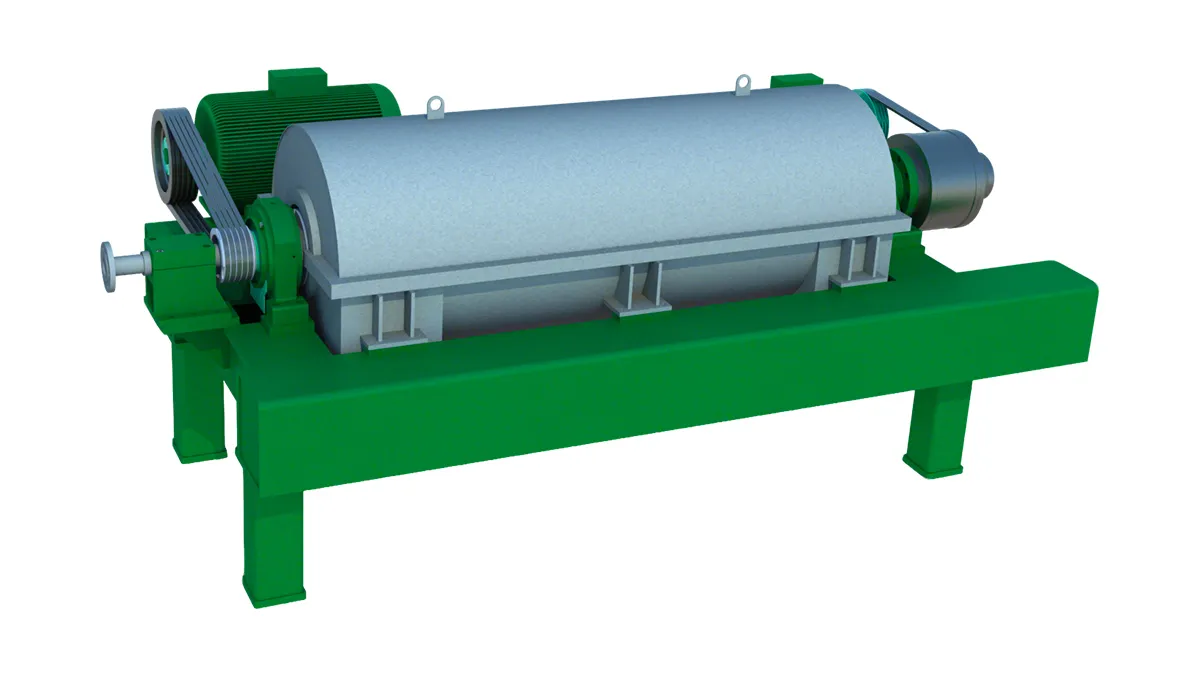
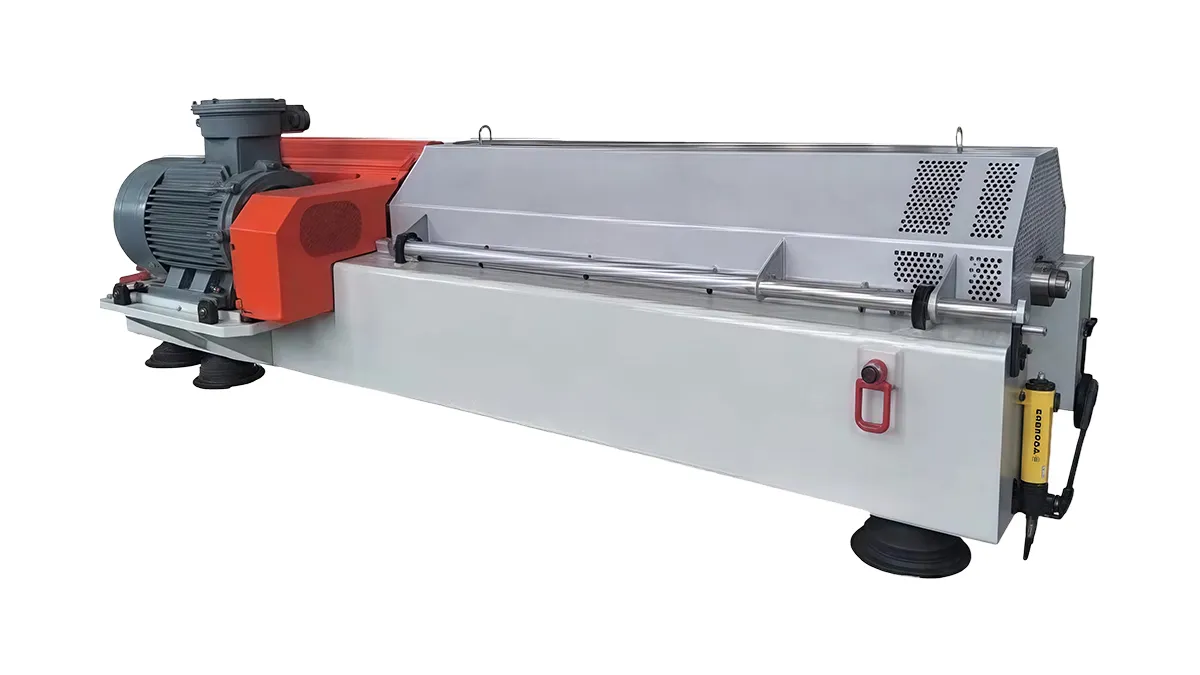
The two-phase decanter is a continuously working solid-liquid separation system that uses centrifugal force to automatically separate the solid and liquid phases while also providing continuous feeding, dewatering, and discharge. It is composed mostly of a conical drum, a scroll conveyor, a differential (gearbox), bearing housings, a cover, and a base.
| Model | Bowl Diameter (mm) | Feed Rate (m³/h) | Main/Secondary Motor Power (kW) | Machine Weight (kg) | Overall Dimensions (mm) |
| |
250 | 1-4 | 11/4 | 1,200 | 2,650×720×900 |
| |
350 | 5-15 | 22/5.5 | 2,000 | 3,585×980×1,238 |
| |
450 | 5-20 | 30/11 | 3,000 | 4,380×1,080×1,360 |
| |
530 | 10-26 | 45/15 | 5,000 | 4,840×1,160×1,465 |
| |
650 | 10-40 | 90/22 | 8,500 | 5,240×1,780×1,850 |
| |
720 | 25-50 | 110/22 | 12,000 | 5,200×1,900×1,620 |
The two-phase decanter is widely used in the chemical, food, synthetic fibre, metallurgical and mining, pharmaceutical, and light industries. In chemicals, it handles solid-liquid separation and dewatering of acidic and alkaline suspensions; in food and pharmaceuticals, it separates citric acid, traditional Chinese medicine preparations, lactose, and similar products; and it is also suitable for separating and dewatering materials such as plastic granules (for example, ABS and PVC), pesticides, and compound fertiliser particles.
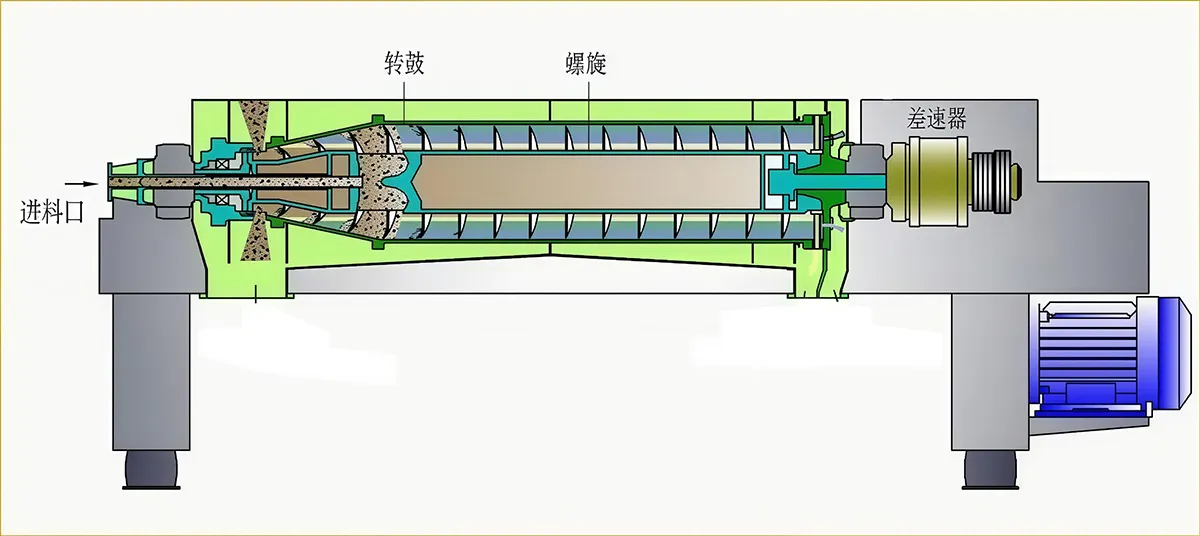
- Feeding: The material that is to be separated is introduced into the drum through the feed conduit in a horizontal feed arrangement. It enters the separation zone between the cylindrical section of the drum and the scroll conveyor after the acceleration cone inside the drum accelerates it to speed.
- Sedimentation and Separation: The material settles and separates in accordance with the density difference under the strong centrifugal field generated by high-speed rotation. The inner region of the settling pond is occupied by the lighter liquid phase, which is displaced by the solids. The denser solid phase moves toward the drum wall and gradually deposits there as a sediment layer.
- Solids Conveyance and Discharge: The scroll conveyor continuously transports the solids that have been deposited on the drum wall to the conical section of the drum, where they are discharged from the machine, thereby achieving continuous solids discharge.
- Liquid Discharge: The liquid phase flows toward the light-phase outlet and forms an inner liquid ring as a result of the axial force component generated in the conical section. The liquid phase, which is typically composed of a heavy liquid like water and a light liquid like oil, dissipates at the large end of the drum. Subsequently, it converges freely and exits the machine.